


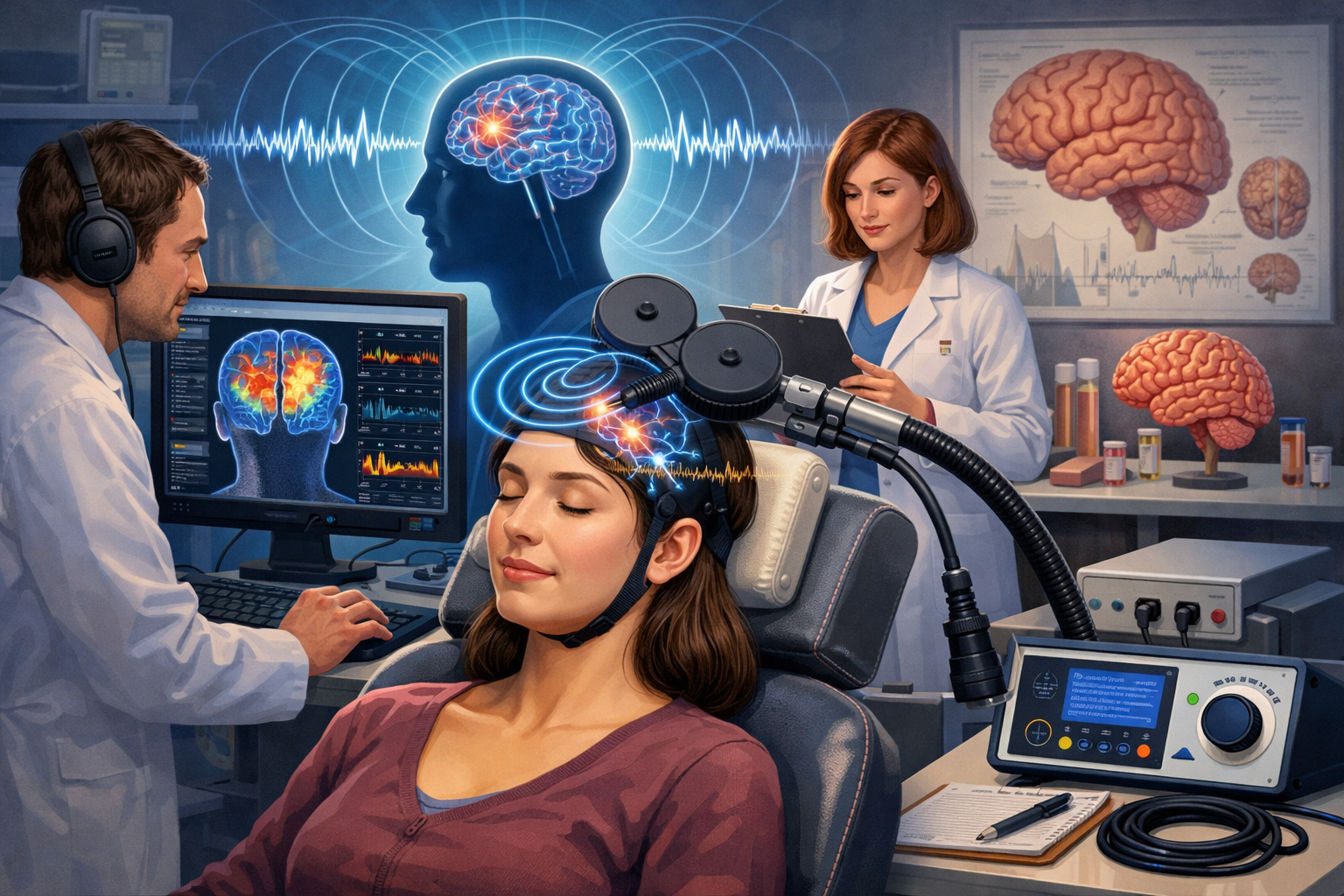
Over the past four decades, Transcranial Magnetic Stimulation research (TMS) has produced a robust scientific foundation supporting its mechanisms of action, safety profile, and therapeutic efficacy across psychiatry, neurology, and cognitive neuroscience. TMS is now widely recognized as a non-invasive neuromodulation technique capable of altering brain network activity and promoting neuroplasticity, particularly in patients with medication-resistant psychiatric and neurological conditions.
This synthesis summarizes landmark studies, systematic reviews, and clinical trials that have shaped the modern understanding of TMS and its expanding role in both research and clinical care.
Foundations and Mechanisms of TMS
Transcranial Magnetic Stimulation was first introduced in 1985 as a method for inducing localized electrical currents in the cerebral cortex using electromagnetic induction. These brief, targeted currents depolarize neurons, allowing researchers and clinicians to map, probe, and modulate brain activity in vivo.
Early experimental work established TMS as a “virtual lesion” tool—capable of temporarily disrupting focal cortical regions to support causal brain–behavior inference. Subsequent mechanistic studies demonstrated that repetitive TMS (rTMS) produces long-term potentiation (LTP)-like and long-term depression (LTD)-like effects, directly implicating synaptic plasticity as a central mechanism.
Neurophysiological evidence indicates that TMS influences excitatory and inhibitory cortical networks, modulating glutamatergic and GABAergic transmission in patterns comparable to pharmacologic antidepressants—without systemic exposure.
Clinical Applications of TMS in Psychiatry
Major Depressive Disorder and Treatment-Resistant Depression
The most extensively studied psychiatric application of TMS is Major Depressive Disorder (MDD), particularly in patients who do not respond to antidepressant medications. Repetitive TMS targeting the left dorsolateral prefrontal cortex (DLPFC) consistently demonstrates antidepressant effects.
Clinical trials and meta-analyses report response rates of approximately 30–50% in treatment-resistant populations. This body of evidence led to FDA clearance of rTMS for treatment-resistant depression in 2008, marking a major milestone in non-invasive brain stimulation.
Emerging Psychiatric Indications
Advances in stimulation protocols have expanded TMS applications beyond depression. Theta burst stimulation (TBS) offers comparable efficacy with significantly shorter treatment sessions, improving accessibility and patient adherence.
Ongoing and completed trials support the use of TMS in:
- Obsessive-compulsive disorder (OCD)
- Post-traumatic stress disorder (PTSD)
- Bipolar depression
- Schizophrenia (particularly auditory hallucinations)
- Adolescent depression, with established safety parameters
Neurological and Neurophysiological Applications
In neurology, TMS serves both diagnostic and therapeutic roles. It is widely used to assess:
- Corticospinal tract integrity
- Motor threshold and cortical excitability
- Interhemispheric inhibition
- Functional recovery potential after stroke
TMS has also been applied in Parkinson’s disease, epilepsy, dystonia, and other movement disorders, where it helps characterize disease-related changes in cortical networks and supports rehabilitation research.
Paired-pulse and repetitive TMS paradigms have revealed abnormalities in intracortical inhibition and excitability across multiple neurological and psychiatric conditions.
Contributions to Cognitive Neuroscience
TMS has transformed cognitive neuroscience by enabling causal testing of perceptual, attentional, and executive function models. Transient stimulation of specific cortical regions can reliably induce:
- Attention and perception disruptions
- Neglect-like symptoms
- Altered reaction times and sensory processing
These findings confirm the functional roles of targeted brain regions and support network-based models of cognition.
Safety, Ethics, and Methodological Considerations
Extensive safety reviews confirm that TMS is well tolerated when delivered within established guidelines, with the most common side effects being mild scalp discomfort or transient headache. Serious adverse events are rare.
Ethical considerations remain central, particularly regarding:
- Informed consent
- Sham stimulation design
- Use in vulnerable populations
- Non-therapeutic cognitive enhancement
Methodological rigor—including reproducibility, coil positioning, and stimulation parameter standardization—continues to be a focus of ongoing research.
Key Takeaways from Transcranial Magnetic Stimulation research
- Mechanism: TMS modulates cortical excitability via induced electric fields and synaptic plasticity.
- Psychiatry: Strong evidence supports its use in depression, with expanding indications.
- Neurology: Valuable for diagnosis, prognosis, and rehabilitation research.
- Cognition: Enables causal brain–behavior mapping.
- Safety: Well established with low risk under standard protocols.
Collectively, these findings demonstrate that non-invasive neuromodulation can reliably and meaningfully alter brain network dynamics, positioning TMS as both a powerful therapeutic tool and a critical research modality.
Ongoing Research and Foundational Literature
Transcranial Magnetic Stimulation Research: continues to evolve, with hundreds of peer-reviewed studies published annually. Below is a curated selection of influential reviews and empirical papers that define the field and trace the development of TMS—particularly in relation to major depressive disorder and treatment-resistant depression.
- Transcranial magnetic stimulation – Ilmoniemi (1999)
Discusses the evolution of TMS from Barker’s 1985 invention to its neuropsychiatric applications by George and others, noting paired-pulse paradigms and cortical excitability studies that informed depression trials. - Transcranial magnetic stimulation: a neurochronometrics of mind – Walsh & Pascual-Leone (2003)
A comprehensive theoretical exploration of TMS, explicitly referencing Barker et al. (1985) and George et al. (1995) as cornerstones linking motor stimulation to cognitive and affective neuroscience. - A History of Transcranial Magnetic Stimulation – Reeves, Deng & Young (2025)
Chronicles the trajectory from Barker’s first magnetic coil to George’s depression trials in the 1990s, situating these works as the foundation for rTMS in modern psychiatry. - Thirty years of transcranial magnetic stimulation: where do we stand? – Ziemann (2017)
Reflects on three decades of Transcranial Magnetic Stimulation Research:, citing Barker (1985) and George (2010) as historical anchors for the clinical use of TMS in treatment-resistant depression. - Biophysical determinants of transcranial magnetic stimulation: effects of excitability and depth of targeted area – Stokes et al. (2013)
Builds on Barker et al. (1985) by analyzing how cortical depth and excitability influence stimulation thresholds—critical parameters for effective rTMS in depression. - Transcranial magnetic stimulation and brain atrophy: a computer-based human brain model study – Wagner et al. (2008)
References the original 1985 paper to model current flow in atrophied cortical regions, informing TMS safety and efficacy in older or depressed populations. - Reduced brain entropy by repetitive transcranial magnetic stimulation on the left dorsolateral prefrontal cortex – Song et al. (2019)
Cites George et al. (2010) and Barker et al. (1985) to connect rTMS-induced neuroplasticity with reductions in brain entropy, reinforcing its antidepressant mechanism. - Transcranial magnetic stimulation in the treatment of psychiatric disorders – Pridmore & Belmaker (1999)
One of the earliest papers directly citing George et al. (1995), analyzing TMS’s antidepressant potential and introducing early rapid-rate protocols. - History, studies and specific uses of repetitive transcranial magnetic stimulation (rTMS) – Noohi & Amirsalari (2016)
Reviews the historical and clinical evolution of rTMS, linking its psychiatric applications to the innovations of Barker and George. - The development and modelling of devices and paradigms for transcranial magnetic stimulation – Goetz & Deng (2017)
Explores TMS device engineering and stimulation paradigms, tracing conceptual lineage to the early Barker and George designs used in depression treatment trials.
Transcranial Magnetic Stimulation Research: is ongoing and ever expanding our knowledge of what conditions it may help. If you have questions or would like to get started, please fill out the form below or call (318) 227-4088 to make your initial appointment.
[wpforms id=”58819″]
